Note
Go to the end to download the full example code.
Deep Learning
Recall that skerch operations admit any linear operator that implements
left- and right matrix multiplication via the @ operator, and the
.shape = (height, width) attribute.
The CurvLinOps library
provides curvature linear operators that satisfy this requirement, for a
variety of very useful objects such as the Hessian, the Jacobian and the
Generalized Gauss-Newton (GGN). It is also implemented with PyTorch as a
backend, but the curvlinops operators actually implement SciPy’s
LinearOperator
interface, so not only they are compatible with skerch: they can also be
used with most of the LinAlg routines available in SciPy.
In this example, we show how to obtain an accurate and full Hessian
eigendecomposition from a deep learning setup, using skerch’s
sketched EIGH combined with curvlinops. To verify the high quality of the
resulting sketched approximation, we apply the a-posteriori test method
discussed in Sketched Low-Rank Decompositions (see also
skerch.a_posteriori).
This small-scale example, which runs in under a minute on CPU, is already
borderline intractable using traditional linear algebra routines. Thanks to
the pytorch backend, we can also use GPU acceleration with minimal
changes reaching substantially larger scales. And we can also reach even
larger scales if we make use of out-of-core, distributed computations (see
Out-of-core Operations via HDF5 for guidelines and
this paper for an application
example).
import matplotlib.pyplot as plt
import torch
from curvlinops import HessianLinearOperator

from skerch.a_posteriori import apost_error
from skerch.algorithms import seigh
from skerch.linops import CompositeLinOp, DiagonalLinOp
from skerch.utils import gaussian_noise, rademacher_noise
Setup
Curvature matrices are a function of a dataset, model and loss function. For this example, we create a synthetic dataset and a model with >30000 parameters, resulting in a Hessian of >1 billion entries.
SEED = 12345780
DTYPE = torch.float32
# medium-scale config to run on autodoc CPU server.
# change to "cuda" and bigger data/MLP to test larger scales locally
DEVICE = "cpu"
DATASET_SHAPE = (2, 50, 784)  # num_batches, batch_size, xdim
MLP_DIMS = (784, 50, 10)
SKETCH_DIMS, TEST_MEAS = 2000, 30

# synthetic dataset, model and loss function
X = gaussian_noise(DATASET_SHAPE, seed=SEED, dtype=DTYPE, device=DEVICE)
Y = rademacher_noise(
    DATASET_SHAPE[:-1] + (MLP_DIMS[-1],), seed=SEED + 1, device=DEVICE
).to(DTYPE)
dataloader = list(zip(X, Y))
model = torch.nn.Sequential(
    *sum(
        [
            [torch.nn.Linear(i, o), torch.nn.ReLU()]
            for i, o in zip(MLP_DIMS[:-1], MLP_DIMS[1:])
        ],
        [],
    )[:-1]
).to(DEVICE)
loss_function = torch.nn.MSELoss(reduction="mean").to(DEVICE)
params = [p for p in model.parameters() if p.requires_grad]
num_params = sum(p.numel() for p in params)

print(model)
print("Number of trainable parameters:", num_params)
print("Number of Hessian entries:", num_params**2)
Sequential(
  (0): Linear(in_features=784, out_features=50, bias=True)
  (1): ReLU()
  (2): Linear(in_features=50, out_features=10, bias=True)
)
Number of trainable parameters: 39760
Number of Hessian entries: 1580857600
Sketched Hessian Eigendecomposition
Now we can create the Hessian LinOp and perform the skerch
eigendecomposition! Some considerations:
If
SKETCH_DIMSis too small, recovery quality may sufferReducing
meas_blocksizehelps against out-of-memory errors, but is slower (less parallel measurements at once)
H = HessianLinearOperator(model, loss_function, params, dataloader)
print(H)
ews, evs = seigh(
    H,
    DEVICE,
    DTYPE,
    SKETCH_DIMS,
    seed=SEED + 2,
    noise_type="rademacher",
    recovery_type="hmt",
)
sH = CompositeLinOp((("Q", evs), ("Lbd", DiagonalLinOp(ews)), ("Qt", evs.T)))
<curvlinops.hessian.HessianLinearOperator object at 0x71386072bc40>
Error estimation
Looks good, but how good is our recovery? We now to estimate the error via a-posteriori test measurements, confirming it is very low:
(frob_sq, f_sq, err_sq), _ = apost_error(
    H, sH, DEVICE, DTYPE, num_meas=TEST_MEAS, seed=SEED + num_params
)

fig, (ax1, ax2) = plt.subplots(ncols=2, figsize=(8, 3))
ax1.plot(ews.cpu())
ax2.imshow(((evs[-200:] * ews) @ evs[-200:].T).abs().log().cpu(), aspect="auto")
fig.suptitle("Recovered Hessian eigenvalues and fragment of $log |H|$")

rel_err = (err_sq / frob_sq) ** 0.5
print("Estimated Hessian norm:", frob_sq.item() ** 0.5)
print("Estimated approximation error:", err_sq.item() ** 0.5)
print("RELATIVE ERROR:", (err_sq / frob_sq).item() ** 0.5)
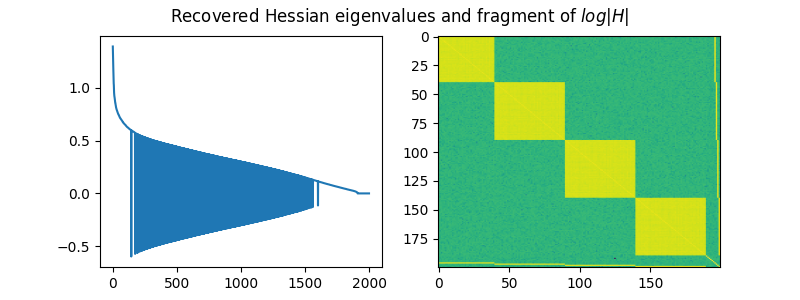
Estimated Hessian norm: 16.62060580585183
Estimated approximation error: 6.613247817472402e-05
RELATIVE ERROR: 3.978945100209745e-06
Total running time of the script: (0 minutes 20.490 seconds)